
Modern Foreign Languages
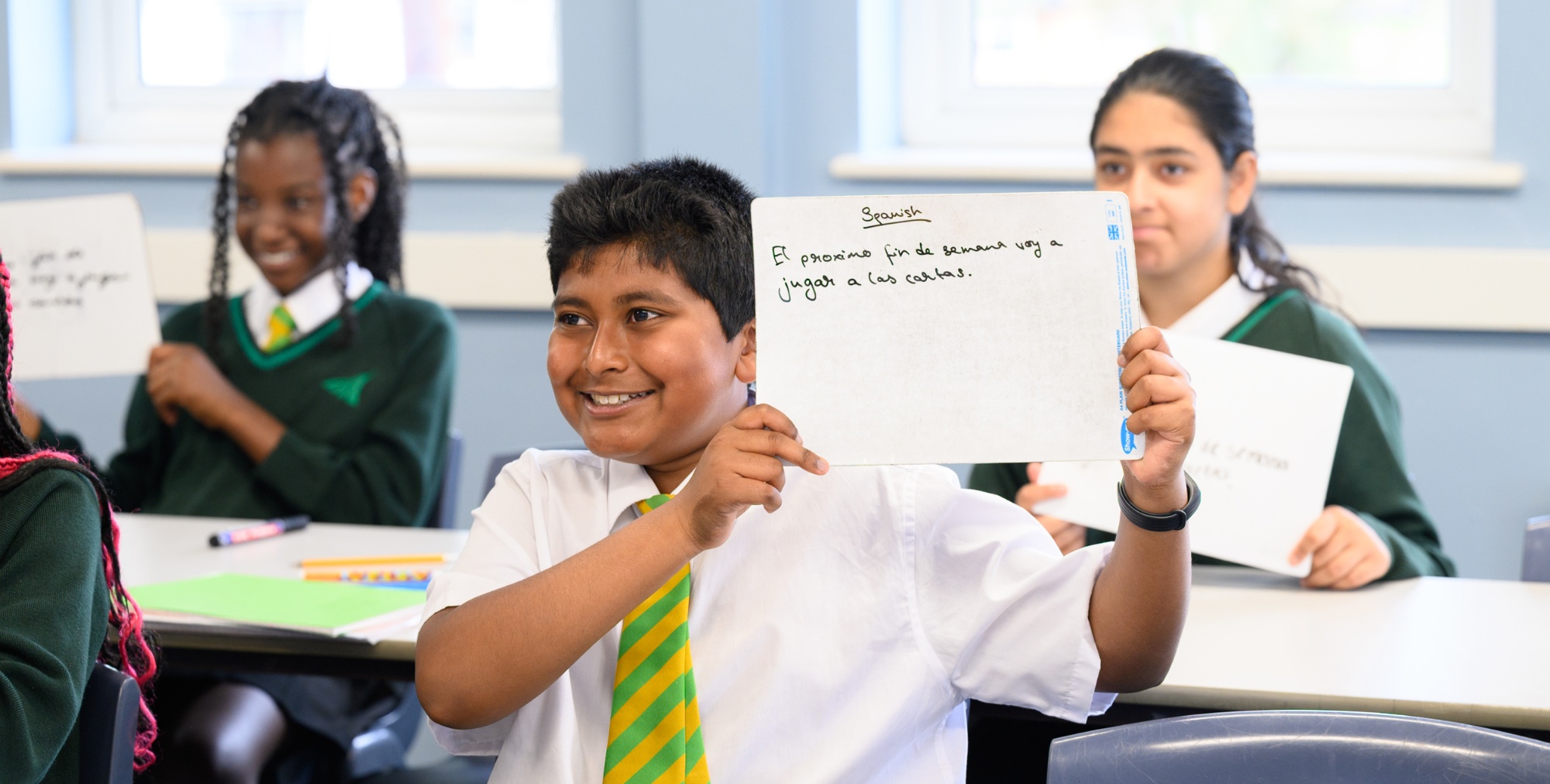
The MFL Department aims at developing students’ fluency and achieving language grammar mastery. It constantly introduces new cultural opportunities to support students’ learning. Past educational visits included trips to Paris, Christmas markets in Lille and Gaudi’s iconic architecture in Barcelona.
A great emphasis in key stage 3 languages is in teaching grammar to build a solid foundation for students to be able to take languages to higher levels. Exposing students to the fascinating culture of Spanish and French speaking countries is also a key element of the curriculum. In addition, students are encouraged to speak the target language they are learning right from the first few lessons, supported by all the necessary vocabulary and high frequency expressions.
In the past few years, a number of language educational trips have taken place to both France and Spain, and students benefited from visiting the SOAS university and engaging in different language workshops. Many have also had the opportunity to participate in exchanges with French and Spanish students who visited the school and spent the day with their pen pals.
Key Stage 3
What are the Big Ideas in modern foreign languages?
|
Tense |
Gender | Phonics | |
|---|---|---|---|
| In Year 7 |
Communicating about the past, present and future relies on the knowledge of multiple verb structures in different timeframes. |
In many languages, words have a gender which affects the form of that word and those associated with it. | Sound patterns are the building blocks of language and vary from language to language. |
How are these developed through Years 7 to 9?
|
Tense |
Gender | Phonics | |
|---|---|---|---|
| In Year 7 |
Simple sentences are constructed to communicate brief information in the present, past and the future using mainly the first person singular. |
All nouns have a gender (feminine or masculine) and adjectives must be of the same gender as the noun they are describing. |
Double vowel sounds, silent letters, accents and key sounds are practiced consistently to build a solid phonic foundation. |
| In Year 8 | Sentences are constructed to communicate information, narrate events in the past and describe plans using the near future, mainly using first and third person. | Adjectives must agree with the noun both in gender and in number (singular or plural). | New and unfamiliar words are pronounced independently, applying previously learned patterns. |
| In Year 9 | Complex sentences can be deliberately constructed to narrate events in the present, past (perfect and imperfect) and near future in detail, and to express ideas and opinions. | Comparative and superlative adjectives must agree with the noun and in French, some perfect tense verbs need to agree in gender and number with the subject. | New and unfamiliar sentences are pronounced accurately and independently. |
Spanish sequencing plan
| Year group | Autumn term 1 | Autumn term 2 | Spring term 1 |
Spring term 2 | Summer term 1 | Summer term 2 |
|---|---|---|---|---|---|---|
|
In Year 7 |
Family and friends |
Sports and hobbies |
Sports and hobbies |
Places in town and transport |
Places in town and transport |
TV and film |
|
In Year 8 |
Relationships and role models |
Food and drink |
Shopping |
Music |
Music |
Future plan and opportunities |
|
In Year 9 |
Module 1: Diviértete! |
Module 1: Diviértete! |
Module 2: Viajes |
Module 2: Viajes |
Module 2: Viajes |
Module 3: Mi gente, mi mundo |
GCSE French and Spanish
GCSE French and Spanish
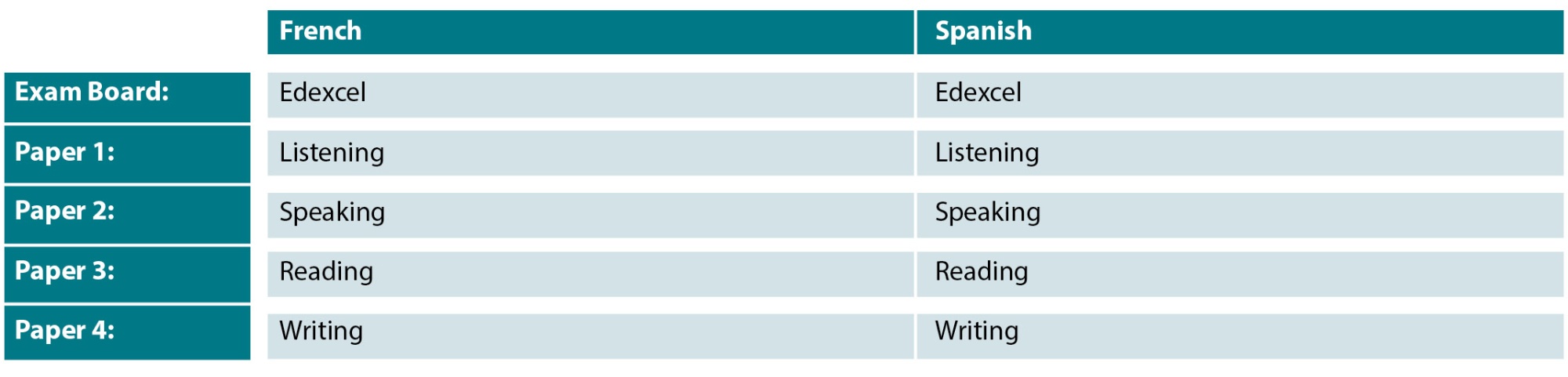
GCSE French Teaching Schedule

GCSE Spanish Teaching Schedule

Downloads to help with classwork, extended work or coursework, can be found on Frog.
Head of Department is Mrs M Sayarh. KS3 Coordinator is Miss J Hughes and Miss Z Coates is Lead Practitioner. Other members of the team are: Miss I Brzostowicz and Mr J Gutiérrez.